Sunday, 22 March 2015

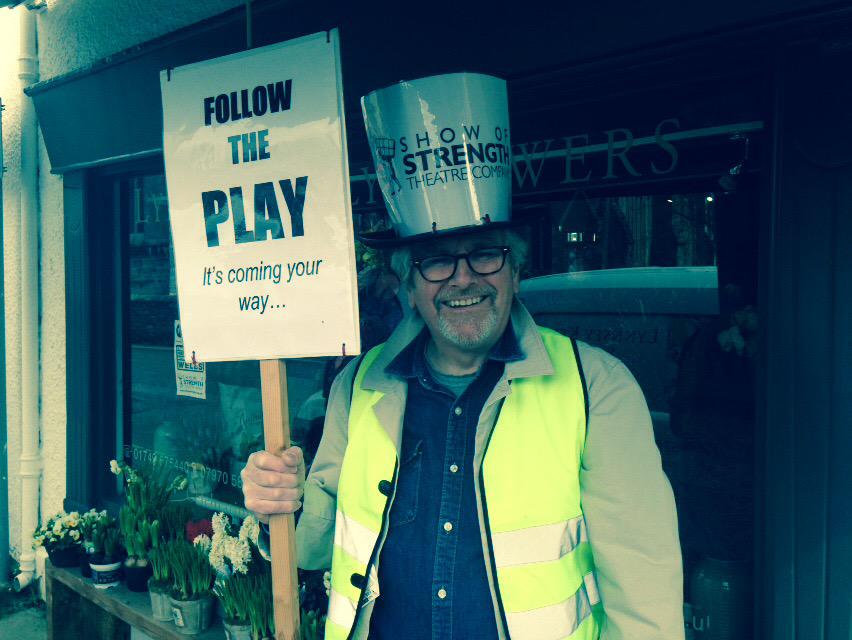
Don't dot shop - flash theatre in the High Street.

Wells Trading Local Festival was like molten blobs of creativity dropping on a small cathedral city and bursting in random places. Where they fell, Saturday shopping world was suspended. A dozen shops became flash theatres. In the corner of a practical commercial space: a supermarket, a school uniform shop, art bloomed. Something happens when a group of people suspend reality together. The audience, crammed between aisles and islands of folded jumpers or kitchenware, hushed rapidly. There was breath-holding and laughter, and at two of the shows, sniffing and eye-dabbing.

The monologue is a great form for immediate intimacy. It is like opening a door in the forehead of a stranger and peering in. There is confiding, vulnerability and revelation. It is an encouragement to wider empathy and greater attention to others in life as well as art.

As one of the writers and a member of the audience I won't see the city and its shops in the same way again. It's now a map of little theatres in my head. The empty stage holds an imprint of magic even when the players have gone.

Move your body not your finger. Don't dot shop. Use your local shops, have conversations, meet real people. You can't do it on Amazon.

Sod got into my phone and drained my battery just as I was about to film my piece, so picture this: Actor David Reakes (like Benedict Cumberbatch but more talented) opened his jacket to reveal a satin ruffled shirt and in the back of a clothes shop he became Prince Steve. You can read the script here.


Embedded image permalink

                    For more about the fabulous Show of Strength Theatre
                http://showofstrength.org.uk/productions/trading-local-wells


Wednesday, 14 January 2015

Creativity v Domesticity: you won't find an orchid in a roller-striped lawn.

Families, like fairy tale bears, have their habitual seats. Mine is at one end of a 1930s sofa. Nicotine-yellowed, it soaked up the smoke that my grandma’s lungs did not. This sofa is actually my desk. One end is confettied with notes and stuff.
  In the surrounding room objects are not privileged or displayed, they are beached: old greetings cards, papery flowers on the mantel, the drift of ashes in the hearth; a dead bonsai’s wintry charm. Their outlines mingle like flotsam and seaweed. Webs thicken and droop like vines, and the dust, as Quentin Crisp said, gets no worse after three years. Things wait to be put away: a pop-up festival tent, the African-snail-that-didn’t-thrive’s plastic tank, a frisbee left by a visiting dog. Fortunately things are infinitely patient because they do not die. It’s just as well because given the choice of a pen or a duster I seize the pen. I don't do tidy - small, vinegar-mouthed word.
I am messy and I have no guilt. (Reminds me of the Patti Smith song: ‘my knees are open to the sun, I seek pleasure' etc. I doubt she straightened the antimacassars before she wrote it.)
If you do have guilt you must be female. Drop it. If you need convincing there are plenty of studies which show that messiness provokes creativity. Disorder can trigger creative solutions. Order is associated with rigid thinking. A disordered environment has depth and history, archaeological layers and surprises. Clutter is interesting. Dirt is a maligned character. It is as beneficial as it is pathological. It nourishes a strong immune system and a diverse biome. Air fresheners and cleaning chemicals lodge in the body with a half-life somewhere between plutonium-244 and a seaborne carrier bag.
I have visited homes as bland and minimal as the local Nationwide. Banks with their clear, clean surfaces don’t taste of anything. You could lick the glass, the wall, the carpet. The only difference would be the texture. I don’t want to live in a bank. I don’t think I could write in one. Einstein famously said: ‘If a cluttered desk is a sign of a cluttered mind, of what, then, is an empty desk a sign?’
Of course there’s clutter and clutter. There’s the chaos of a Mumbai rubbish tip and there’s the ordered disorder of a non-linear mind; a sophisticated, highly individual filing system that cannot be reduced to algorithms. It nourishes the random, the providential, the serendipitous, the inspired.
Organic and organised have the same root. Ordered disorder is nature’s way. Ordered order is topiary, borders, selective planting. Ordered disorder is a meadow where everything finds its symphonic niche and somewhere in the grass is a single wild orchid. You won’t find an orchid in a roller-striped lawn.


Some of my ordered disorder, enhanced by a broken horn in the log basket and a part-lobotomised Gandalf on the hearth.

Wednesday, 5 November 2014

How to fill a church - Show not tell.

In writing as in art, show not tell.


Damien Hirst's 'Fallen Angel' and David Mach's 'The Thief'.


Show not tell: possibly the most common advice given to beginner writers. It doesn't always hold. Sometimes a simple 'She was sad,' is preferable to 'Her eyes gushed like an open fawcet'. Anyway, a visit to the Crucible 2 sculpture exhibition in Gloucester cathedral got me thinking about the subtler lexical scope of 'showing'. The sculptures were a masterclass. A thousand-idea matrix of associations linked them one to another, and with the setting.

Edward 11's effigy could not have been more dead. Stiff, cold, stony; dethroned by the common marks of 18th century graffiti. At its feet Henry Moore's Bone Skirt, earthed, curvy as a slug river. Each is a commentary on the other; the sum greater than the parts.

A gilded angel is unremarkable on the altar of a cathedral, until you see the cross-hatched forearms, the tourniquet, the spoon and syringe. The attitude is not prayer or repentance but heroin stupor. Behind her the sacrificial table, and saints in fractured glass stepped to unreachable heights. The eloquence of the pairing is exquisite. A still-life sermon on suffering, desire, temptation.

Framed by the arches the thief with his cross. Fifteen feet high, anger and resistance on a face made of coat hangers. Christ to his right is slumped, surrendered; rugged and stratified as though birthed in a quake from his crucifix. People gaze in silence but the volume of dialogue between the pieces is high.

We monk-tread the oyster shadows of the cloisters, plain song hovers in the roof shells. And here is a man, modern but primitive, the base schema of aboriginal lines in red plastic. The sculpture is more brazen in its solemn setting.

The power of the exhibition lies in the interplay. So it can be with writing. There are unspoken dialogues between ideas, scenes, characters, individual words. In a poem it is clear that spaces and frames matter.  Prose can 'show' in ways which go beyond action, body language and metaphor. There's meaning and fascination in surprise juxtapositions: solemnity and wit, anger and surrender, rigidity and motion.

Note to the ArchB of C, the cathedral was packed for two months. Show not tell could be the way to go.

Sunday, 5 October 2014

The Stolen Child

Inspirations - there's one of mine. Mike Scott, sitting behind the book-signing desk in the festival tent: black hat, musical mist about him, song in the lilts of his speaking voice, minstrel to his bones. Shook the hand that strums. He wrote on my book.

Listened to him earlier in conversation with screenwriter, Richard Curtis (4 weddings, Black Adder). Mike is Richard's musical hero. Richard got teary just speaking the lyrics of Mike's songs. I know how he feels.

When I first heard 'The Stolen Child' I cried. The words of Yeats spoken in a brogue made of peat smoke. How can music smell green as the wet of water-mint, make a dawn-dim dell of the ceiling dark, show faery faces in yellow-damp woodchip, bear the host of the sidhe on the window draught, take us back where morals don't even matter because all is play.

The vision comes with wist and yearning. We have a pact. Eternal childhood is forfeit. Our destiny is to return and suffer. That is our pass out, not the hand of a faery. Oh, but we're drawn...

I've now begun book 3 of the Waifs trilogy. I've called it Nigma. It's informed by Yeats' poetry and Mike's music. My hope is that, for the space of a sentence or two, it calls the human child away to the water and the wild. This side of the divide is lighter when a poem, a song, a book, opens to the other and sends us out to play.


Monday, 29 September 2014

Satsang with Kosi


It's said in some circles that the next stage of human evolution is accelerating. The ego is a construct, a suffering manufactory that can be dropped. There's a contagion of waking up. Illuminated dominoes.

 I've reached the final edit of Book 2 in the Waifs of Duldred series. The waifs arrive in a utopia called Nondula. I'll leave the reader to figure out why. Its people have rumbled ego for what it is and kicked its ass.  Yesterday I went looking for Nondulans.

Bristol. The glass and gloss of Cabot Circus. House of Fraser, Reiss, Harvey Nicks. There's a fashion show; grim models strut hips first to a thumping beat. The back roads of Bristol. A woman meticulously weeds between cobbles. A grapevine overhangs a wall. Tiny haemorrhoids.

 I forgot the house number. Mostly there are clues through the windows: rainbows, chimes, crystals. I push the door. Incense. People are seated; they look long and unseeing at the carpet, quick and seeing at each other. There are always two or three with clear eyes.

Kosi's assistant has these clear eyes. He tells us Kosi likes to begin with a meditation. She will arrive by car. He will go out to meet her. He will be filming, does anyone object? She will leave on time so please ask all questions within the session. The energy in the room can be intense so be prepared.

The cynic reads this as mystique-building. Wait and see.

She arrives smiling, greeting. Warm American voice. Black trousers, white shirt, blue scarf, sensible shoes. Her skin is careless smooth with a sheen. A classic angel, yellow hair, brimming eyes. The cynic lasers for flickers of falsity. Nothing. We meditate. She chants trailing into 'shanti, shanti, shanti'.

Kosi speaks. Advaita. Standard. She invites questions. A woman - black shawl, knotted eyes - goes up. Kosi holds her hand. The woman has had blissful experiences and openings. She cannot come to terms with world suffering. She wakes every day with the pain of it. Kosi peels the onion. The woman sheds. Guided back to her five-year-old self, she lets go.

A young French man goes up. He is angry. He is angry at the angry people who act without thought and harm each other. He wants to fight the fighters. She guides him to the real source of his anger. He lets go.

A woman with snowy hair and a story face takes her turn. She has gained self-realisation through many years of spiritual tourism, daily meditation, and art. These things served to a point. What next?

There's sincerity and commitment. The teacher feels genuine. The clear-eyed ones I guess are already Nondulans.

I'm a way off, still scribbling.

Sunday, 14 September 2014

Coleridge woz 'ere

 Coleridge Cottage, Nether

In Nether Stowey, visiting Coleridge's cottage. Coleridge lived here for two years. In that time he produced all his best work. There's a vial of laudanum on the shelf of his writing room. Out of the bottle swim sacred rivers, ectoplasmic ancient mariners and damsels bright. It feels like the scene in Indiana Jones when the Ark is opened and the winds of spirit are released, the holy and the unholy.

I wander on, beams above, flags underfoot. Here he ate, here he slept and made love. My thoughts fall into rhyme and metre. Invited to scratch an 'I woz here' note with a quill: clumsy, bleeding words.

In the garden I ate his blackberries, his bitter apples. Southey appeared over the garden wall. Coleridge looked into the eyes of Southey over the garden wall.

The well has a cool, plinky magic. A brick-lined tunnel with the mystery of lakes; what lies in the depths? Gibbet-like with its winding rope; death by letting down, not hoisting up.

There is a cafeteria. People are public-eating, slow-buttering scones, pouring tea with fingers on the lid, saying that things are 'nice' or 'lovely'.

I leave the cottage and walk his walk, hear his stream, see in his colours. Pass Walford's Gibbet in the high corner of a sloping field. Here a man hung for the murder of his wife. A dying place; his last moments were these, this field, these birds, this air, and thousands gathered to watch. Why? It was eight years before the time of Coleridge. Would he have watched? Would he have written about it?

Eat under a crooked tree among the heather, fern and gorse. Through woods to Bin Combe. Here he wrote 'Nature! Sweet Nurse! O take me in thy lap - And tell me of my Father.'

A poet's mind bathes in the juice of poppies, the milk of paradise. Beware, beware, his flashing eyes, his floating hair. There's danger in the depths of wells.

Or sip tea, visit the National Trust gift shop, stay safe where this is 'nice' and that is 'lovely'.


Sunday, 10 August 2014

Novelty junky

Image result for balloon fiesta free images

There's a list in The Huffington Post of 18 things creative people do differently. They:
daydream, observe everything, work the hours that work for them, take time for solitude, turn life’s obstacles around, seek out new experiences, ‘fail up’, ask big questions, people watch, take risks, view life as an opportunity for self-expression, follow their true passions, get out of their own heads, lose track of time, surround themselves with beauty, connect the dots, make time for mindfulness.

Last night I was tired and hungry. So why, after a day’s work, did I go to the Bristol Balloon Fiesta nightglow, alone in the rain?

The faces were beautiful in the dusk, so many, so various, so many heads carrying so many stories. The movements of children, lifting smoothly from the churned grass for a better view, orbiting their parents like electrons buzzing heavy nuclei. The beautiful Japanese girl sitting cross-legged on the grass, great symmetry to her face, mouth like a bruise, steals a chip from a boy, swirls it in salsa, eats. The voice of an android ‘Seven minutes to inflation.’ Manic bulb-studded fairground. Cold, quiet trees. The people organism commutes the walkways. A boy twirls a liquorice lace, catches the end in his mouth, ingests in gathers. The fudge tent, like a building yard for sugar igloos. ‘One minute to inflation.’ The flaccid casings ripple and begin to rise with a giant’s breath. Puff, they grow. I’ll huff and I’ll puff. Hemispheres rising. Full and lovely they rise, a dozen air balloons. In the crowd miniatured balloons on a thousand phone screens. The balloons glow, fired in synchrony. The music, M-people, ‘I can feel my soul ascending.... what have you done today to make you feel proud,’ a West country anthem, ‘Ruby, Ruby, Ruby, Ruby,’ the crowd sing ‘oo-ar, oo-ar, oo-ar.’
The balloons shrink and sink becoming cloths, just as ghosts become sheets, dolls and clowns lose their night-time animation, and the human spirit fleas the body. The sky explodes.

It was irresistible to me because I'm a novelty junky and it ticked at least half of the boxes above. There it was: rain turned to atmospheric beauty, people-watching, new experiences, observing everything, out of my head, solitude in a crowd, mindful, forgetful of time, connecting dots and asking questions. Oo-ar.